

My dear esposa is very worried about the way things might be turning with the commencement of the Tariff Wars.
She makes a cogent point that tariff wars almost never deliver on their promise to make things better for those who start them. Wink wink, Mr. President Trump, eh!
This is why she is deeply concerned with the volatility of the economic spillover that will impact Canada.
But I am still on the fence in this respect. There are still too many unknown factors affecting the outcome here.
For one, we do not have a clue as to how much Trump is invested in this move. Is this political move for real? Does he intend to wage a sustained blow‑by‑blow strategic trade war with Canada/Mexico and the world? Or is this just a tactical move meant to deliver a powerful message: reinforce your borders or else!
I personally believe this all started as a tactical move and Trump is surely happy to reap the rewards of all his trading partners falling in on immigration.
But the situation is even more complex.
Fact is that in 1985 at a time when President Reagan was firmly behind Free Trade, America’s share of the world GDP had maxed out at 35%. Back then the United States brought in a third of global GDP.
At the same time, China was pulling in only 2.5% of world GDP.
Reagan couldn’t have been more right even if he tried to. He had all the reasons to support free trade. That was back then.
Fast forward 40 years later and America’s share of world GDP is at 26% while China’s is hovering around 17%, neck in neck with the EU.
Not the same situation now, folks, eh!
Back then, America was making and selling stuff. Lots and lots of it. China was not even coming online.
Right now, America is taking in a quarter of world GDP while China has increased her market share 7x.
If Reagan was alive today, do you think he’d be for Free Trade or against it?

In any case, America had to make a protectionist stand or risk losing it all.
But still, this doesn’t do anything to put my wife’s worries to rest.
She may be right to be weary of the future. And I may be wrong to treat the tariff wars as unavoidable.
Thing is I like Trump’s approach. The man is unpredictable. He really is. And not only that. He is a consummate negotiator. He wishes to appear tough but also soft. He is like a steel gauntlet in a velvet glove.
This is why I believe his approach may well be only a negotiation tactic. But anyone can read anything into it.
Although, the fact that both Mexico and Canada acquiesced to American demands for a stronger border in no time, prompting the postponement of the tariff wars, that kind of vindicates my point. But who’s keeping tabs, eh!
Intermezzo
Coming back to Montesquieu, this eminent 18th century enlightened French philosopher wrote a bunch of treatises that had the following principle at their core: the world then (Nota Bene: or now) is what it is due to the climate.
For instance, Africans are lackadaisical happy go lucky worry not‑types because they enjoy a hot climate that provides them with no incentive to transform their existence into a better experience. There are almost no external pressure points for them to change. So, they don’t.
In opposition, Europeans having been forced by a harsher climate into an eternal struggle against the elements, were forced to develop their minds, their society, and economy to keep up with the environmental pressure points to the point whereby Europe has taken the developmental lead, which made it into the colonial powerhouse it had become by 1750.
Regardless of what you may think of his reasoning, the man was on to something.
How many of us change if they don’t have to?! Really, raise your hand if you ever changed in anticipation of a major shift. Or, and this is mighty important, you only adapted to circumstances as they arose.
So, in short, if things were good, you remained put, in your bubble, content to do your thing as per usual.
And only when things started to change (for better or worse), that’s when you spurred into action.
And if that is true for you and me, people, why would this not apply to a continent, other people, then as now, and in general.
Truth is change is a powerful motivator. But if Providence provides for you, why bother moving your behind an inch from your static position?! Why would you do anything differently, indeed!
As for Europeans, they couldn’t play the same waiting game with Nature. I mean, you can blame it on the Sun, cosmic rules, astrophysics, celestial mechanics, God, you name it. This is what four seasons will guarantee you each year. You may lounge like a sultan or like that proverbial Lafontaine’s lazy-ass grasshopper from April to September, but come October, your tough-ass will get going towards that industrious ant or the going will certainly get tougher for you.

But why did I bother you with my 18th century homage to Montesquieu?
Easy, because of the Finns.
Armed Neutrality is Dead! Long live Trump’s Protection Fee!
Wait, wait! What? WTF does Montesquieu have to do with Finland?
Let me take it slowly. I am going to step back a bit so that I can better advance my reasoning.
Context
Historically, Finland and Sweden have embraced armed neutrality for a long time:
Finland since 1948 and Sweden since 1812.
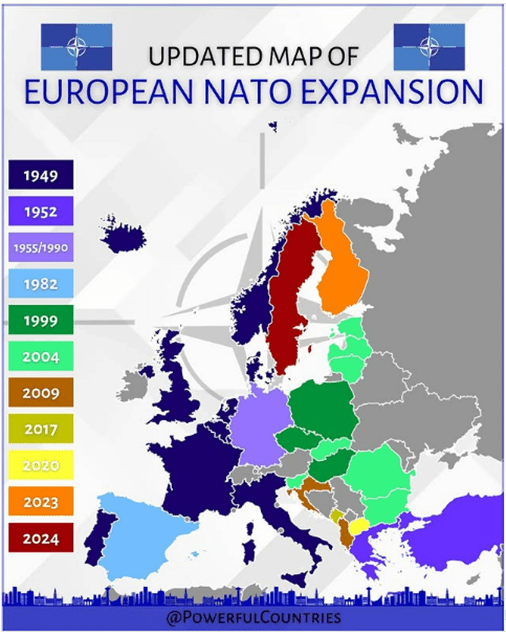
You see folks, neutrality is the way to go when you want to opt out of the arms race or just do not want to gamble away your national savings on chasing the pipedreams of generations past.
Things are simple. We tend to overcomplicate matters by overexplaining them.
As a country, you either rely on yourself for protection (definition of neutrality) or you rely on a Big One. You can take your pick between an alliance like NATO, or the USA or Russia or any others.
If you choose the former, you must pay for defense yourself. That means you have to keep up your military spending, preparedness, readiness, manpower levels, etc. You are your own boss.
If you choose the latter, you must do the bidding of the major player underwriting the said alliance. That means you gotta pay up, step up, and purchase armaments greenlit by the Head of the Alliance or Bloc you are a part of. It means you have a Boss now and when they say “Jump!” you reply “How high, sir, yes sir?”
So far so good, eh!
One way or another, you have to spend money on defense. There’s no two ways about this.
Now, in the past staying neutral meant you had to spend a mint of money to keep up with the Joneses. Like a lot more than what the Joneses, who were part of an alliance or bloc, were spending.
In fact, that is exactly why America had started to resent the modus operandi of her NATO allies.
While the U.S. military budget approaches $1 trillion per annum, or 3.4% of GDP, being the biggest military appropriation in the whole world, the 30 NATO members’ average stands at 1.96% of GDP.
For your information, the NATO spending target is 2% of GDP. And up until very recently, the situation was even more dire than it is now. As you can clearly see, most of NATO comprises of loungers who are content with criticizing Washington for its militarism and military‑industrial complex while letting the Americans foot the bill. This has led to an imbalance between security giver and takers.

As the situation stands, America can no longer sustain this business model, whereby her allies save up on their defense budgets, while she assumes the financial weight of military spending.
It is at this point in time that the late comers, Finland and Sweden, decided to join the NATO party.
Historically, the Finns have always liked to fight, hunt, and tame nature. Montesquieuian determinism clearly applies here. The function created the organ. In short, Finland knows how to fight. As for accepting responsibility for their defense, that era has come and gone.
Talk about sweet irony, eh.
Military spending one‑on‑one
Back in 2016/20, Trump called on NATO countries to contribute their 2% of GDP for defense. Some heeded his call. Others figured they didn’t have to.
Fast forward to 2022, Putin invades UKR.
By 2024, staunchly neutral countries like Sweden & Finland join NATO after doing the math & figuring it’s better to spend 2% under NATO than more than that outside its umbrella, as neutral countries.
Surprise, mother-lovers
Sweden
As a neutral country, Sweden spent 1% of GDP per year between 2011-19 and 1.5% GDP in 2023.
Under NATO, it will spend 2.4% GDP in 2025 (projected).
Finland
As a neutral country, Finland spent 1.63% of GDP in 2020, 2.1% in 2021, and 1.9% in 2022.
Under NATO, it will spend 2.5% of GDP in 2023.
The Finns aim to spend around 2.3-2.5% of GDP per year on arms for the next three fiscal years.
But 2024 comes and Trump is back in the POTUS chair.
Now, Washington wants NATO countries to contribute 5% of GDP each.
So, the Nordic ex-neutrals were spending below 2% of GDP beforehand. The UKR war starts, and their military spending goes up. They decide it’s not worth it being responsible for their own military budgets as neutrals when America can bloody well protect them… for a modest fee, eh.
So, they join NATO. They even start spending 2% of GDP or more to show faith.
But hey, America says it ain’t enough! 5% is a must NOW. Hahaha sweet irony! Sweet bloody irony!
Critique (mostly from the Left)
Some people, when they hear of military spending, imagine a big black hole that sucks in money, which is people’s labor, without giving anything back to the working taxpayers. Actually, the textbook quoted by these peeps go something like this:
4) High military spending can divert resources from other critical areas such as education, healthcare, and infrastructure, potentially hindering long-term economic growth.
And while they aren’t wrong, they are not right either. Because why? Because, when push comes to shove, folks, people will let babies starve so that their armed forces have bigger bats and swords.
This is how the world operates. Security trumps everything else. If you add to this underlying consideration the fact that America is created on the principle of making the military-industrial rich while the entire country crumbles around them, you get the picture.
The discussion is much larger.
Do you wish to know how much money America has spent on atomic weapons between 1940 and 1996?
I will tell you. Courtesy of the RAND corporation’s reports: $5,500 billion (PPP, 1996). That is $11,275 billion (PPP, 2025). In other words, the United States of America spent $11 trillion and the small change of $275 billion of today’s money on atomic weapons in 56 years.
To put this amount in perspective, the White House says it has sent more than $275 billion to UKR as military aid in the last three years.
Talk about waste, eh…
And America ain’t done spending money on her military forces.
As of 2024, the United States is currently replacing or modernizing nearly every component of its strategic nuclear forces. This modernization program, which will continue through the decade and into the next, will require at least $540 billion in acquisition costs. The new strategic delivery vehicles will cost an additional $430 billion to operate and maintain over their lifetimes. The National Nuclear Security Administration’s weapons activities will require an estimated $650 billion over the next 25 years.
In total, the modernization of U.S. strategic forces will cost at least $1.5 trillion over their lifetime.
We have a saying in Romania.
De aia nu are matza coada.
Word for word, that’s why the cat is missing her tail. Meaning, that’s why we cannot afford good things no more.
As always, the military choose to fight the next war using the last war’s weaponry. Is that really smart? I guess only time will tell.
In the meantime, China is choosing to spend its smart money on future looking programs, like the Mianyang large‑scale laser fusion research center that will aid nuclear weapons design and power generation. The experiment bay at this facility is 50% larger than the U.S. National Ignition Facility.

Conclusion
The world has joined a new arms race. Weapons costs money. Trump’s tariffs are meant to reinvigorate and rejuvenate American industry and economy. This will make it more resilient financially and able to support the increased level of spending commensurate with the new Arms Race.
 Götterdämmerung