

Napoleon once called the Belgian port of Antwerp/Anvers “a loaded pistol aimed at the heart of England”.
The English themselves believed this to be true. In 1809, they sent Lord Chatham, a.k.a. “the late earl” for his propensity to show a leg rather close to noon, with 40,000 troop to make sure the French did not shoot their ‘Belgian pistol”.
The expedition was doomed from the start. Poor leadership, coupled with the local terrain conditions (putrid marshes and lowlands), made short work of the ‘lobsters’ as the English soldiers were called, due to their red and white uniforms.
By the end of the failed expedition, 10,000 troops remained incapacitated by Walcheren fever, with some 60 officers and 3,900 soldiers having received their Theta (KIA) mark against their names.
By comparison, enemy action had made only 100 casualties in the British ranks.
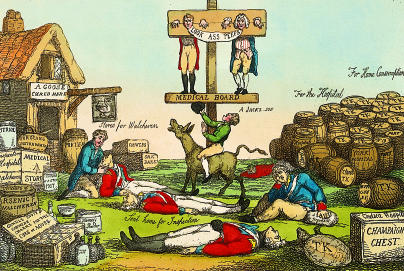
That the British lost most of the land battles but still won the Napoleonic Wars, is public historical knowledge.
The fact that they gambled with soldiers’ lives thus ought to tell us how important it was for England to make sure that pistol was not going to be fired at her.
That they lost the Walcheren campaign matters little.
What counts the most is the fact the French could not press their naval advantage to the point where they could build up an invasion fleet and a suitable Navy that would actually put French troops on English soil.
This is a lesson that was not lost on the great strategic minds of the last couple of centuries.
One must remember that it was England that neutralized Belgium, guaranteeing its sovereignty as early as 1839.
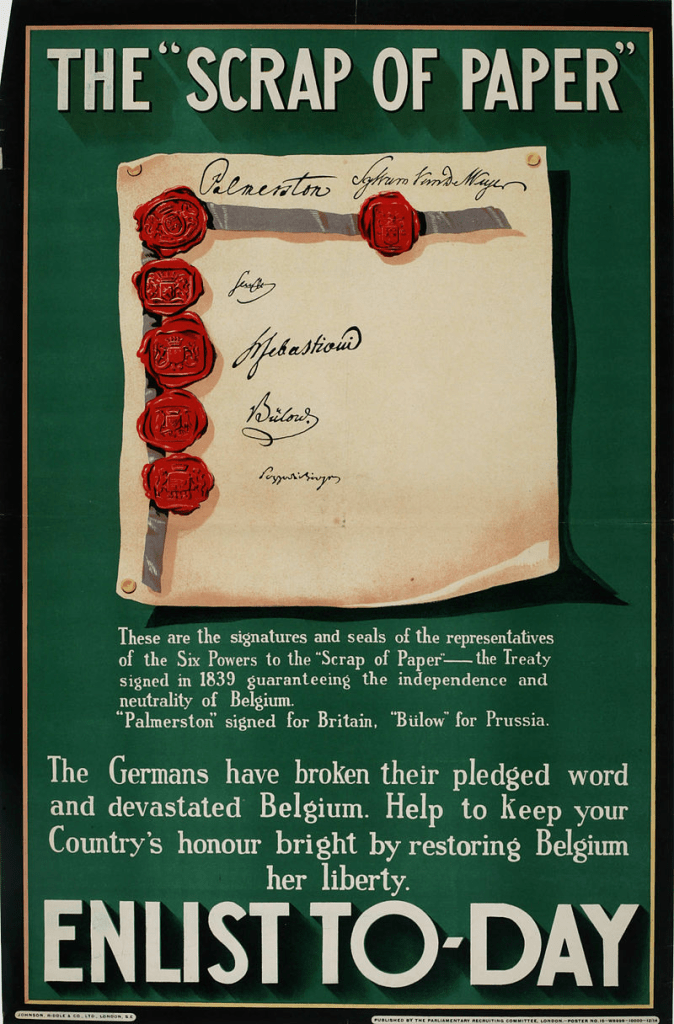
At the time, Mister Palmerston had affixed his Seal in the name of Her Majesty’s Government to prevent the French from growing too big and unmanageable. You see, in 1831, the French had sent an army into Belgium to make sure the Dutch speaking Flemish would not overcome the French speaking Walloons.
The solution proposed, adopted, and sealed by the Concert of Europe (Austria, German Confederation, France, Britain, Belgium, Netherland, and Russia) was enshrined at the Treaty of London of 1839 that guaranteed two things:
- Belgian Neutrality was a matter of public international law.
- World War One would start, on paper, once a signatory of the Treaty would break its pledge.

World War One had many underlying causes and a few cassus belli, but it was the German Army’s crossing the Belgian border on August 4 that triggered the British declaration of war the same day.
This is what happens when German chancellors declare binding international treaties “chiffons de papier” or scraps of paper.
Case in point
100 years later, in 2014, France and Germany mediated the Minsk Accords to arrest the purported destabilization of Ukraine by Russia. This series of two international agreements, were signed by the following list of dignitaries:
- Swiss diplomat and OSCE representative Heidi Tagliavini
- Former president of Ukraine (July 1994 to January 2005) and Ukrainian representative Leonid Kuchma
- Russian Ambassador to Ukraine and Russian representative Mikhail Zurabov
- Rebel heads Alexander Zakharchenko and Igor Plotnitsky[14]
They were meant to foster peace in Ukraine along the following principles underwritten by the signatories:
- To ensure an immediate bilateral ceasefire.
- To ensure the monitoring and verification of the ceasefire by the OSCE.
- Decentralisation of power, including through the adoption of the Ukrainian law “On temporary Order of Local Self-Governance in Particular Districts of Donetsk and Luhansk Oblasts”.
- To ensure the permanent monitoring of the Ukrainian-Russian border and verification by the OSCE with the creation of security zones in the border regions of Ukraine and the Russian Federation.
- Immediate release of all hostages and illegally detained persons.
- A law preventing the prosecution and punishment of people in connection with the events that have taken place in some areas of Donetsk and Luhansk Oblasts.
- To continue the inclusive national dialogue.
- To take measures to improve the humanitarian situation in Donbas.
- To ensure early local elections in accordance with the Ukrainian law “On temporary Order of Local Self-Governance in Particular Districts of Donetsk and Luhansk Oblasts”.
- To withdraw illegal armed groups and military equipment as well as fighters and mercenaries from the territory of Ukraine.
- To adopt a programme of economic recovery and reconstruction for the Donbas region.
- To provide personal security for participants in the consultations.
On paper, all was kosher and halal.
Unfortunately, while the diplomats were shaking hands, Germany and France knew that the Minsk Accords were not meant to be executed by the Ukrainians.
Their role was to give UKR time and space to rearm, refit, and regain the initiative to defeat Russian separatists and win the war.
The problem with their calculation was two-fold:
- Ukraine could never defeat Russia, a country much bigger, much stronger, and much more motivated to win the war. For UKR, the war was going to be an exercise in futility. For Russia, the war was an existential one.
- Russia did not sit idle between 2014 and 2022. It also rearmed, refitted, and made its economy sanction-proof and resilient. In fact, it can be said that the war was won by Russia before the special military operation even started. They made sure they had the logistics on their side, not trusting the inherently perfidious nature of the Collective West.
Eric Weinstein, an American physicist and mathematician recently said something that struck home.
This gent cogently articulated how in 1999, when he watched NATO extend Article 5 security guarantee to Poland, he was quite in agreement with it. After all, Poland is quite far away from Russia.
Then, in 2004, the same security umbrella was granted to the Baltic countries. Riga, Weinstein mentioned, and I just checked on Google Earth, is 844 km as the crow flies from Moscow.
Kiev, one should note, is 758 km away from Moscow.
Now, I do not know how folks feel or think about the Ukrainian-Russian War.
But I will tell you that if I was in charge in Russia, I would not give a flying fig about any state’s sovereignty if that country was part of a foreign military alliance… and in close proximity to me.
On any given day, most Russian or American ICBMs can hit their targets within 42 minutes from launch. In order to do so, they cover approximately 11,150 km in less than one hour.
Let’s do the math, shall we…
At an average speed of 265 km per minute of flight time, regular American missiles placed on NATO territory, in the Baltic states, would cover the distance to Moscow, the capital of the Russian Federation in 3 minutes 10 seconds flat.
The same regular missiles would get from Kiev to Moscow in just 2 minutes 52 seconds flat.

Please note we are not even talking superfast hypersonic missiles here.
A hypersonic warhead could cover the same distances in less than two minutes.
The same missile scare happened in 1962 in Cuba and resulted in the near annihilation of civilization.
In the end, Khrushchev withdrew his ICBMs from Cuba (70 km away from Key West) and the Americans followed suit by pulling their Titans out of Turkey.
This is why Russia has invaded Ukraine. And this is why any country bordering Russia that decides to join NATO or any foreign military alliance, is not safe.
No country will ever countenance respecting another country’s security if the latter decides to enter into a foreign military alliance. Because if it did, it would pay the price of its foolishness sooner rather than later.
 Götterdämmerung